Saturday, February 8, 2014

Is the virtue of financial transparency of political parties over-rated?

Is Financial Transparency of Political parties a Virtue in itself ? Or is only a means to get to an end of Clean Money-power free elections (which is the Virtue) ? Should we over-rate the means at the cost of losing sight of the end goal ? 


Is the existing system broken as some people claim? Or is the existing system only in need of some fine tuning to catch up with the reality? 


Check out on this on my recent post on CRI website (Click here


Tuesday, January 21, 2014

Kumudam Reporter 2014 Survey - Part II

This blog post in continuation with the earlier blog post on the Kumudam Reporter survey for 2014 elections. This is the English Translation of the Part-2 of the 2014 Lok Sabha pre-poll survey conducted by Kumudam Reporter Magazine and published in the issue dated 26.1.2014 (but appeared in the stands on 21.01.2014).  The website of this magazine is here . It is a paid, subscriber only magazine for online consumption. All copyrights of this survey rests with the source. The only purpose of translating the results is for the benefit of people who don't read Tamil. 

Quick Summary (my personal note) 
  1. The best ever scenario for ADMK is to have a four-way (or even 5 or 6 way) contest whereby the opposition votes split. In a four-way contest, ADMK+ manages to come on top with 34.2% vote share. So Jayalalitha will be eagerly watching for the alliances (or the lack of it) among her opponents before she announces her own strategy. 
  2. The best ever scenario for BJP is to form a mega alliance with MDMK, PMK and DMDK, which they are currently attempting. Under this scenario they can give a tough fight to ADMK+ as they are within 2% vote share of the leader, by managing to get 32.4% vote share. Even if the DMK and Congress tie-up they wont be able to beat BJP from the 2nd position in this scenario. 
  3. The best ever scenario for DMK is to form a grand alliance with DMDK and Congress. They can thwart ADMK's plans and manage to come on top with 33.2% vote share in this scenario. ADMK+ comes close with 32.9% (less by 0.3%) leading to a neck to neck fight. While DMK is already negotiating with DMDK, they also need to rope Congress in. Without congress this alliance won't be able to challenge ADMK+ in the first past post electoral system. 
  4. BJP which has had a 5% vote share at best in the past (in elections where they have not allied with any of the big Dravidian parties) but they are poised for their best  ever finish in Tamilnadu in 2014. They alone have now managed to build a 19% vote share. With a mega alliance, they can get sizable seats in the LS polls. Survey reports say this wave has less to do with BJP as a party, but is more in favour of the persona of Modi and his Development Oriented Agenda.
  5. Captain Vijayakanth's DMDK has once again proved to remain the "game changer" in Tamilnadu elections. Although they have dropped their individual vote share by about 2% from their heydays, they still remain the deciding force. Hence the frantic parlays underway by both BJP and DMK to lure captain into an alliance are completed justified.  
For more insights refer to the bottom of this blog post. 

Results 

The results for the final 2 scenarios are given below. For details of the Survey Design, Sample size, Sample Stratification etc. refer to the earlier blog post. 

Scenario-2 : Four-way contest with  DMK Alliance (DMK, VCK, PT, MMK), ADMK Alliance (ADMK, CPI, CPIM), BJP Alliance (BJP, PMK, MDMK, DMDK) and Congress. 

Scenario-3: Three-way contest with DMK-DMDK-Congress Alliance (DMK, Congress,DMDK, VCK, PT, MMK), ADMK Alliance (ADMK, CPI, CPIM), BJP Alliance (BJP, MDMK, PMK). 

Result of Scenario-2

Scenario-2 is the best case scenario for BJP where it forms a formidable alliance by roping in Vaiko led MDMK, Ramadoss led PMK and Vijayakanth led DMDK. This scenario assumes  that DMK and Congress contest separately. 

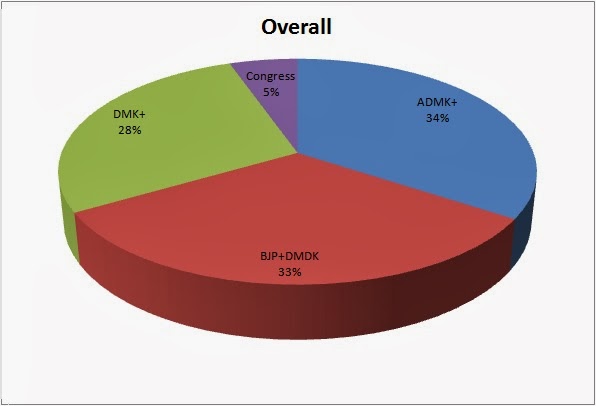
The results of this scenario show that ADMK alliance still tops the vote share (34.2%), however their vote share drops to within 2% range of a whooping 32.4% acquired by the BJP alliance, enabling a neck-to-neck fight between the two alliances. DMK alliance is pushed to third spot in this scenario with 27.9%. Congress manages to retain 5.4% in isolation.  


Among age-groups, the youth segment (18-40) is overwhelmingly supporting the BJP+ with a vote share of 35.1%, while ADMK+ comes second with a close 34.8%. DMK comes third among youth voters with 27.2%. However among the older voters (40+) ADMK+ continues to hold sway with 34.8%, while BJP+ has only 27.2%, overtaken by DMK+ with 31%.


Based on education levels, BJP+ is a huge hit among people that have completed college education with a whooping 39.4% vote share. However ADMK+ is most popular among uneducated / school dropouts with a 43.6% vote share. The worrying sign is for DMK+ which manages to get only 25.7% among those with at least a college degree. 


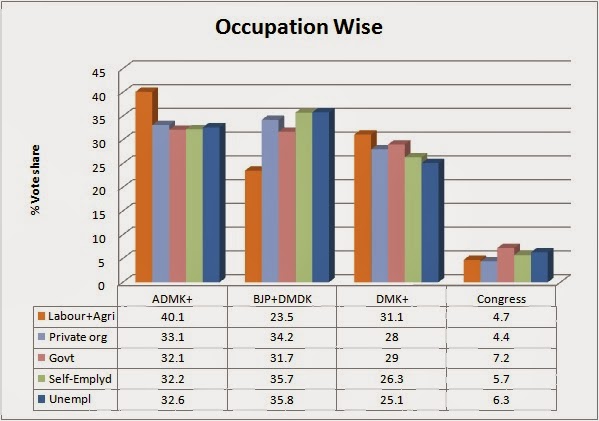
Based on occupation, ADMK+ manages to hold sway among Agriculturists and Labour with a 40.1% vote share, while BJP+ fares third in this segment with 23.5%. In all other occupation segments, BJP+ leads over DMK+. The worrying sign for ADMK+ is that, among the private employed people, self-employed/enterpreneurs, and unemployed (including students) BJP+ is ahead of even the ADMK+. This shows that ADMK+ tops the vote share in this scenario, mainly because of the vote of Agriculture/Labour and Government employees.


Results of Scenario-3 

This is the best case scenario for DMK, where it allies with both Vijayakanth led DMDK and Congress. The results reveal that DMK+ becomes the front runner in vote share with 33.2%, outwitting the ADMK+ which has 32.9%. However the gap of 0.3% is a close call and will result in neck to neck battle between the two alliances. In this scenario, BJP+ is pushed to third spot with a vote share of 28.1%; which is still an achievement from the past. There are 6% voters who are undecided (or NOTA) who can make the difference on the outcome.  


Regarding the age group wise analysis, the youth segment (18-40) is heading for a three way split with a close call ; ADMK+ has 31.9%, BJP+ has 30.3%, and DMK+ has 31.1%. So in some way the voting pattern of the senior voters (40+) decides the final outcome, where DMK+ (36.9%) has a 2% lead over ADMK+ (34.9%), with BJP+ dropping to 24%.


Based on education levels, ADMK+ continues to retain its whooping edge among uneducated and school dropouts with a 43.8% voteshare, whereas BJP+ is reduced to 15.7%; a distant 3rd. With a strong alliance DMK+ manages to close in on this segment with 36.9%. However despite this grand alliance of DMK+, among voters with a college degree, BJP+ continues to hold a handsome lead by topping with a 34.7% vote share. 


Based on occupation, ADMK+ see a drop in its vote bank among agriculturists and labour to 39.4%, which allows DMK+ to claw back to 37.1%. BJP+ gets only 19.4% in this segment. However among the Privately employed, Self-employed / enterpreneurs, and Unemployed (including students), BJP+ still manages to give a close fight to the other two alliances. 


So overall the results reveal the following significant insights. 
  1. BJP is up for its best performance in Tamilnadu in 2014 polls without allying with any of the two major Dravidian parties. Results show that this vote surge has less to do with BJP as a party, but due to the personal popularity of Narendra Modi and his development oriented agenda. 
  2. There is a heavy negative vote towards the UPA government. However for the DMK, allying with Congress is still important to counter the might of ADMK. 
  3. Despite three years of ADMK rule in the state, anti-incumbency has NOT set in and Jayalalitha seems to have maintained her vote share from 2011 state elections intact. Her core vote bank appears to the older voters (40+), uneducated/school dropouts, and those involved in agriculture/labour. (So one can expect more populism before the election rules come into force!). 
  4. Among demographic segments, the educated, urban youth (age 18-40), particularly the ones working in private organizations, students, self-employed, entrepreneurs appear to be the "new core" vote bank for BJP. BJP should focus on this segment and ensure these votes do not drift (to other parties including AAP) in the lead-up to the elections. 
  5. Although Captain Vijayakanth's DMDK has lost about 2% vote share from the 9% it secured in 2009 polls, it still remains the "game changer" in Tamilnadu. If DMDK allies with BJP then BJP is up for a close top-2 finish with ADMK. If DMDK allies with DMK, then DMK will be able to give a tough fight to ADMK and can even manage to outsmart Jayalalitha's ambitions at the centre.  

Friday, January 17, 2014

Kumudam Reporter 2014 Survey - Part-I

This is the English Translation of the 2014 Lok Sabha pre-poll survey conducted by Kumudam Reporter Magazine and published in the issue dated 23.1.2014 (but appeared in the stands on 17.01.2014).  The website of this magazine is here . It is a paid, subscriber only magazine for online consumption. All copyrights of this survey rests with the source. The only purpose of translating the results is for the benefit of people who don't read Tamil. 

Kumudam Reporter magazine conducted a survey across Tamilnadu between the dates 02-Jan-2014 to 05.Jan.2014. 


Sample Size & Demographics 

  • The survey covered 2000 respondents of which 73.5% were men. 
  • Among respondents, the age group 18-25 constituted 20.9%, 26-40 was 43.2%, 41-55 was 25.8%, and 56+ was the balance 10.1%. In summary, 18-40 constituted 64.1% and 40+ was 35.9% of the sample. 
  • Among respondents, people who are uneducated & did not complete school was 15.4%, people who have completed schooling was 48.6%, people who have got a degree or more was 36%. 
  • Among respondents, people who work as labour or in Agriculture constituted 21.2%, working in private organizations was 28.9%, Self-employed / Entrepreneurs were 25.7%, Government employees was 11.1%, and Students and unemployed was 13.1%. 
The survey demographics and validity of results were verified and compiled by Professor of Statistics in Madras University, Professor T.R. Gopalakrishnan. 

Survey Design 

Since the alliances in Tamilnadu are unclear at the moment, the survey asked three questions for different scenarios. The scenarios are described below. 

Scenario-1 : All parties stand on their own, without any alliance. 

Scenario-2 : Four-way contest with  DMK Alliance (DMK, VCK, PT, MMK), ADMK Alliance (ADMK, CPI, CPIM), BJP Alliance (BJP, PMK, MDMK, DMDK) and Congress. 

Scenario-3: Three-way contest with DMK-DMDK-Congress Alliance (DMK, Congress,DMDK, VCK, PT, MMK), ADMK Alliance (ADMK, CPI, CPIM), BJP Alliance (BJP, MDMK, PMK). 

Only the results of Scenario-1 have been published in this week's issue. The other two scenarios are going to be published in the subsequent issues of the magazine, and we promise to translate them for you (when they come out). 

Survey Results for Scenario-1 

The results of the overall position when each of the parties stand on its own (without any alliance) shows that ADMK (33.1%) has a 6.5% gap over DMK (26.5%) and tops the list. Vijayakanth's DMDK has been pushed to fourth position to 7.3% vote share, while the Modi effect has led to a surge in the BJP vote share to a whooping 17.8%. PMK retains fifth position with 5.1%. While Congress which once had the 3rd largest vote share has dropped to the bottom of the pile with a meager 4.3%. Vaiko's MDMK has a vote share of 2.3%. 

Not only educated voters, but even rural uneducated voters appear to be aware of Narendra Modi. Certain voters in Pudukottai district said, they have traditionally voted for the Congress, but this time we are going to vote for Modi. In several places, Christian voters were backing Modi. A certain respondent called Bhoopalraj (protestant christian) in Tuticorin said that, "If India has to progress, then we need a change, and we think Modi can deliver that change". It was surprising to observe that in Ramanathapuram district, several Muslim voters also voted for Modi. 

Many of the urban educated people complained why AAP was missing on the list and about 0.1% voted for AAP, despite that not being offered as an option. The support for AAP is spread both in urban and rural areas, among educated youth in the 18 to 40 bracket. This includes both Men & Women. Many of this AAP supporters ticked BJP in the survey. In Turicorin district some college students said they were even willing to campaign for AAP. Hence if AAP can come out with a strong state level leadership, then the damage will primarily be for the BJP in terms of vote share, given below. 


Both DMK and ADMK have voteshare that is above the overall % among the older voters in the 41+ bracket. Among this the gap is severe for DMK which has a 6% difference, compared to the 4% difference of ADMK. BJP has 15% support among older voters (41+) while has a 19.1% support among the youth voters. All the other parties (barring congress) have their youth vote share higher than older voters share. Congress has 5.5% vote share among 41+ voters while has a meagre 3.5% vote share among the youth in 18-40 bracket. 


Based on education levels, ADMK is hugely popular among the uneducated / school dropouts with a whooping 41.4% support, while DMK has 29.6% support. ADMK is relatively less popular with people who have completed school (35.3%), and even lesser with degree holders (27%). The equivalent numbers for DMK are 28.5% and 22.8%. BJP has a massive 24.1% support among people with a degree, where it overtakes DMK to the 2nd position in the state.  Both DMDK and PMK derive their support base from middle group while tapering on both sides. Congress has least popularity among the middle group. It is also worth noting that the category Others (which includes MDMK and communists) have 9.1% support among the degree holders, which is higher than PMK and DMDK. 


Regarding the occupation wise split, ADMK again has a whooping voteshare among the labour + agriculture community with 40.5%, while DMK has 30%. The gap is secularly in the range of 4 to 6% between ADMK and DMK in the other groups, with the lowest gap among the government employees. BJP has the lowest support base among labour & agriculture at 10.6%, while among other occupation groups they enjoy a 18%+ support, with its highest of ~ 20% among self-employed and entrepreneurs. DMDK and PMK both have similar pattern of support base, with their lowest to be among government employees. Congress surprisingly enjoys 6.5% support among government employees and 7.3% from self-employed voters. 

The results of the Scenario-2 and Scenario-3 will be published in the subsequent issues of the weekly. We will have the results translated, as and when they are out!

Monday, January 13, 2014

Vikatan 2014 elections Pan Tamilnadu Survey results (in English)

Many friends wanted to read an English Translation of the Survey results for 2014 elections  (across Tamilnadu) published by Tamil Magazine Vikatan dated 19th, Jan, 2014 (but published online much earlier). So I thought of helping people out by translating the same. Please note all copyrights of this article exist with the source. 
The original link in Tamil is given here. 


Which Alliance would win ? Who would be the PM in 2014? 

The election countdown has started, alliances are still uncertain, leaks of alliance discussions are triggering huge excitement ; In this situation we decided to survey people to check out on answers to questions such as "which alliance should Vijayakanth's DMDK join?", "Which is the strongest alliance? " , "Who will be the next PM?" etc. A team of 90 reporters of Junior Vikatan setout to survey people from all corners of Tamilnadu and surveyed 9174 respondents including 3402 women. Here are the results. 

Regarding DMK's decision to quit alliance with Congress, we asked people a question on what do you think about this decision ? The choices were "right decision", "wrong decision", and "crass opportunism". But over 50 percent (52%) of respondents said this is crass opportunism. This flies in the face of earlier media reports about people being broadly supportive of DMK's decision to part ways with Congress. 

Regarding the potential alliance between DMK and DMDK, about 41% of the respondents have stated that such an alliance will be called "opportunistic" and 37% had stated that such an alliance will not be acceptable to people. 

Regarding the "mega" alliance of BJP, MDMK, PMK and DMDK, about 41% had stated it to be an "alliance of contradictions". 

What will Vijayakanth do is a huge suspense before people at the moment. For this question, majority of the people (33%) said DMDK should contest alone. Further 26% said they should join hands with BJP, and 21% said they should ally with DMK. 

For the question of who should Congress appoint as their PM candidate, there was a huge reaction & anguish from people. They were angry that, when we don't like congress, why ask such a irrelevant question to us? Why haven't you given us an option of  "no comments"? However despite this limitation, among the people that answered this question, over 50% preferred Rahul to the Congress PM nominee. 

Regarding who should be the next PM,  about 48.5% voted for Narendra Modi as PM. Rahul is in second position with 15.63% votes, others at 16.19%. Despite the ADMK campaign about Jayalalitha for PM, only 12.47% voted for Jayalalitha as PM. 

For which alliance would you vote for?, BJP alliance got 40% of the votes. ADMK and DMK alliance have fairly equal votes at 22.7% and 21.77% respectively, with ADMK having a slender 1% lead. Congress got 10.21% of the votes. However during the survey we observed that there is a huge groundswell of support for the AAP, and people complained why they were not included as a choice. In fact many who ticked for the BJP alliance, complained about not having AAP as a choice. 


Understanding the Creature called AAP

What kind of a creature is AAP? Can it quickly scale-up across the nation as many media pundits seem to suggest? What are the implications to their bottom-up organization structure? Is such a structure good for the country or does it lead to major adverse side effects that have long-term implications to the country? 


Check out on answers to these questions - in my post on CRI website. Click here 


Tuesday, December 17, 2013

The furore over Devyani !

If one was following English mainstream media in India or twitter, the entire nation of India seems to have been outraged over the arrest of deputy consular office Ms. Devyani Khobragade in Newyork. The entire nation is outraged by the treatment meted out to her, notwithstanding her diplomatic immunity claims. The nation is particularly infuriated with the arrest in public space (when she was dropping her kids at school), strip searching, stay in the lock-up for 6 hours with drug addicts; and some reports even claiming cavity searches and DNA swabs done on her. The US department of state insists that consular immunity applies only for offences committed as a part of her job and not on domestic/private note. The interpretation of the diplomatic privileges enjoyed by personnel under the Vienna convention act has always been subjective among nations. This is not the first case of interpretation differences and is certainly not the last one. In this article, we shall stay strictly clear off this topic of immunity, because as a practice they appear to be “accorded” or “negotiated” between nations.

I find the outrage in India bizarre and misdirected for multiple reasons.

Firstly this is such a bigoted country that on one-hand wants to enact a law of minimum wages to domestic maids and on the other-hand appears to condone offences of the same nature, in places where such laws exist. It is surprising to see that, not a single word has been uttered in top-ranking ministers, officials or media anchors on the treatment meted out to the domestic maid of Ms. Khobragade, Ms. Sangeetha Richards. The case against Devyani is that she misrepresented facts in the A3 visa application and also under-paid her maid way below the minimum wages applicable in her district of work (Manhattan, New York). On a historic day when the Rajya Sabha has passed the Lokpal bill which demands highest standards of integrity and probity from public officials, it is bizarre that there is no outrage about the fact that a high-ranking diplomat has violated this wilfully?

Let us look at the details of the case against Devyani. (Read here for details of the charge against her as given by the US authorities). The minimum wage prevalent in district of New York is $9.75 per hour. Assuming a 40 hour work week, and 4.3 weeks per month, Sangeetha needs to be paid a monthly salary of $1677. That works to just over $20K per year which is reported to be in line with the average market salary of full time domestic maids employed in US(read here). However the A3 visa application of Sangeetha Richards quoted a monthly salary of $4500 that is consistent with the first employment contract signed between the two parties. However there exists a oral agreement and a second employment contract (which was hidden at the time of applying for visa) which promised wages of Rs.30,000 per month ($573 per month) with no cap on weekly working hours. Why did Devyani offer such a high salary for the domestic maid, far above the market value, far above prevailing minimum wages, and as some people say far above what she can afford from her salary? The only plausible explanation is that there was “no application of mind” done in drafting the contract, or filing the visa petition, because the intention was always to defraud the whole process. What surprises me is that no-one is outraged about this unjustified behavior of a high-ranked public official.

Secondly, the subsequent sequences of actions also seem to be suspicious. Sangeetha Richards worked for the period Nov 2012 to June 2013. Whatever the personal motivations are, she reported the issue to the concerned US officials and went absconding in the USA around June 2013. The US officials had seized upon this issue and had sent an advance warning to Indian officials as early as Sep 2013 on the case to be filed against Devyani. What stopped the Indian consulate from taking immediate action and deporting Devyani back to India? This would have saved all the trouble!. But instead, the moment trouble seems to appear in the horizon, Devyani files a petition of dishonouring of contract against her maid in a Delhi court. There are reports that the husband & child of Sangeetha Richards have been arrested in India, and have been asked to urge Sangeetha to surrender in the Indian court. These strong-arm tactics that were set in motion in India strongly indicate that the intention of the diplomat was to bully the complainant to withdraw the case & not come back to India. People familiar with Indian law are aware that, police actions on employment dishonouring cases are extremely rare; that too when the accused is absconding. There were numerous such cases filed by software companies in the Y2k days for breach of contract; and no police action was taken. Hence it is not easy to see, how well-connected the diplomat is, to be able to instigate such strong-arm actions in India. For people who naively believe that Ms. Khobragade is a rags-to-riches IFS officer, please read the link here on her stupendous growth of her personal wealth & her real estate purchase spree (including the much famous Adarsh apartment in Mumbai). Is this behaviour an archetype of integrity and probity of public officials that we are celebrating with the passage of Lokpal?

The actions involved in “intake” and “processing” (such pathetically euphemistic words they use in the US!) of people being arrested appear to standard operating procedures in the US (Check here). If there is a violation then Devyani and Indian consulate can always sue US officials and we can be assured that the guilty shall pay! However there appears to be little justification for such a suit because no one involved is even talking about it! Hence except for the fact that we are “pained” by the treatment meted out to a “babu”, we seem to have no other grievance in this issue. May be, we are so used to seeing handling by velvet gloves for well-connected babus in India, we are unable to accept such the non-existence of differential treatment in western countries.

Whether diplomatic immunity applies or not is another issue which I am staying clear from. Hence all the counter actions that Indian government have taken to rebuke US are justified from the point of view of reclaiming immunity. US has always employed double-standards in the topic of diplomatic immunity of their own international staff and has played hard ball with many countries. Hence I am not critical of these diplomatic actions taken by India. But what I am critical about is the continued silence of our top ranking officials/ministers/media (even as a token measure) on the violation of integrity & probity by a public official! Unless we do that in strict terms, we can't have any ethical right over the moral high ground in this topic!. 

Friday, December 13, 2013

Ahead of 2014 – Analysis of Forces Driving a Change in Tamilnadu

Introduction

Tamilnadu is an atypical state in India where both Congress and BJP are politically irrelevant and dependent on the Dravidian parties viz. Karunanidhi led DMK and Jayalalitha led ADMK for winning elections. Since the death of MGR, these two parties have followed a perfect revolving door policy in governing Tamilnadu for the past 24 years. Ever since the heydays of the Dravidian movement in 1960s and the demise of Rajagopalachari, the land of temples has witnessed an increasingly shrinking space for right wing politics. Until a few years back, the only right wing political space that appeared to exist was on a linguistic basis, acerbated by the sufferings of Tamils in neighbouring Srilanka. So much is the dearth for right wing ideas (both economics and politics), virtually every media house in Tamilnadu is of a varying shades of Left. The only exception appears to be Cho Ramaswamy’s Tuglaq with limited circulation. The politically correct language in the dictionary of Tamil media is to espouse left-wing economic thoughts, secularism of the Dravidian variety, and Tamil linguistic identity.

Congress dominated the undivided Madras presidency since Independence. However the split between Rajagopalachari (swantara party) and Kamaraj irrevocably altered the political scene enabling the Dravidian movement to assume power in 1967. The split between MGR and Kalaignar Karunanidhi in the mid 70s further marginalized the role of congress. Since then Congress has been playing the role of “bridesmaid” with its 10 to 15% vote share piggy backing on the Dravidian parties. The last five years have seen these shares waning down further. The role of BJP has been fringe at best with whatever little support restricted to pockets in Kanyakumari and Kongu (Coimbatore) districts. Their vote share has loitered between 2% to 4%; the only exception is the 1998 and 1999 elections when BJP allied with the Dravidian parties and won a handful of MP seats. BJP has thus far been perceived as a political untouchable in Tamilnadu. 

But something appears to have changed suddenly in the ground!! The first part of this series performs an analysis of the forces that are driving this change.

Forces Driving the Change

The factors driving this change are complex and often counteracting. Some of these factors are short-term politics driven while others are longer term and socio-cultural/socio-economic in nature.

Short Term Political Factors
The first and easiest one to quote is the antipathy towards the Congress. Besides the corruption and governance issues of the UPA government in the centre, a popular belief has emerged that Congress is behind the sufferings of Tamils in Srilanka. The wave of antipathy was so severe in the 2011 assembly elections that congress & its ally DMK were decimated. In fact among the 5 congress MLAs in the TN assembly, only one comes from an interior district, all others are restricted to the border areas with Kerala and Karnataka. This has made UPA and Congress an untouchable party for many of the outfits. Not that the opportunist politicians of TN would mind joining UPA-3 if they were guaranteed of a win. In the current national climate of anticipation of UPA drubbing, allying with congress is a big nuisance that can invite the wrath of Tamil nationalist groups. Hence even the “love-hate” relationship between 10 year allies, DMK and Congress appears to have turned sour for good.  

Although the mainstream Tamil Media has been by and large dismissive of Modi and the Gujarat model of development, it has definitely caught the attention of middle classes and business classes. For a state severely affected by power blackouts, the 24-hour electricity of Gujarat is not something that can be easily dismissed. Three media houses Tuglaq, Kumudam group, and Trishakti padippagam have been giving positive views on the Gujarat model of development. The threat of Auto industries (from Sriperumpudur cluster) and Textile industries (Tiruppur cluster) relocating to Gujarat due to manpower and energy availability has not missed people’s attention. There is a huge curiosity quotient that Modi has raised & it is hard to miss! The success of the Sep 26th rally in Trichy has ruffled several political feathers. For a detailed account, read here.     

Longer term Socio-Cultural/Socio-Economic Factors

There is a subtle and genuine decline in the Dravidian ideologies and thoughts. Despite what the leaders of Dravidian parties say and their media houses write, the public at large appear to have seen through the smokescreen of Dravidian politics. Thanks to Director turned politician Seemaan, the year 2012 witnessed open criticism against Periyar’s (E.V. Ramasamy) ideologies and a consequent debate ensued. Although the debate was triggered from the ultra-right linguistic side, the panic among Dravidian theologians was visible. They suddenly realized that their foundations are not so impenetrable. Now the linguistic nationalists and the supporting media houses are split as Dravidian variety (who are more centrist) and Tamil variety (who are ultra-right). Not that such debates matter a lot to the public at large, but the split opens an opportunity for right wing politicians to be critical of Dravidian political agenda, without the risk of being dismissed.

The twenty years of super-fast economic growth, rise in income levels of population, burgeoning middle class bracket, and rapid urbanization has had its effects. For one the value of left-wing economic thinking that has dominated the political discourse for several years has come into question. Although mainstream media houses such as Vikatan continue to spew venom against right wing thoughts, most of the middle classes have become apathetic to such views, at the least. Urbanization and emergence of nuclear families have resulted in a longing for spiritualism within families. The moderation of the Brahmin hegemony in temples, arrival of OBC led spiritualism of the forms of Melmaruvathur Adhi Parasakthi movement have created a supporting environment. Today even the local DMK members publicly visit Hindu temples and conduct yagnas and havans without fear of rebuke from their state leaders. The perceptible change in all this is that, the anti-Hindu core paradigm of Dravidian movement is no longer able to dictate/influence individual actions.

The last two years has also witnessed hardening of positions between OBCs and SCs. The Dravidian movement united them on the same plank under the umbrella of anti Brahminism. The success of this movement is now being questioned by Dalit leaders and Scholars such as Ravikumar of VCK and Sivakami (Former IAS). Their complaint is that Dravidian movement has replaced the Brahmin hegemony with OBC hegemony & nothing in the ground has changed for the Dalits. However the urbanization, real estate boom, decline in farming have freed the Dalit farm labours from the clutches of land owning community. Today they prefer to educate their children in private schools and take-up urban-centric jobs rather than toil in the farm for a pittance. This has resulted in the weakening of social power enjoyed by the land owning communities, further accentuated by the shortage of farm labour affecting their agricultural profits. The recent communal clashes in Nayakkankottai (Dharmapuri district) is perceived by many social analysts as a violent expression of the OBC community against the wealth accumulated by the Dalits from their urban jobs. This growing vertical fissure shakes the foundation of Dravidian politics.  

Finally certain events in the last year have led to a subtle under-current of thinking that favours the politics that BJP espouses. Notable among them are the violent protests witnessed over the screening of thuppakki and vishwaroopam. It not only dismayed most of the “secular” middle classes, but has made them alert to the threat of emergence of a right wing politics of different kind. Even the centrist Muslim parties like IUML are now concerned about the emergence of Wahabi school of thought funded by Saudi petro dinars. (Read here for details). These radical groups are resisting age-old practices of Dargah worship & Urs festivals and urging people to follow puritan practices such as shunning idol worship, mandatory cladding of burqah & sporting of beards. This change has raised concerns among the Hindu community on the endurance of the secular social fabric that Tamilnadu has been famous for. The serial killing of BJP and Hindu outfit leaders in the past two years & the subsequent bursting of an alleged terror network have also added fuel to this thought process. Many people are now beginning to see the pitfalls of minority appeasement politics at the cost of national security and personal religious freedom.

 Conclusion

To conclude the situation in the ground before the 2014 elections is radically different from what it was in the previous decade. On a short-term basis the prevalent Anti Congress mood opens avenues for discussing alternatives; and even Modi is not an untouchable as observed in the writings of Tamil nationalist writer & activist Thamizharuvi Manian. The long term socio-cultural changes have weakened the grip of Dravidian theology on the 70% population that lives in urban dwellings. Issues such as growth, infrastructure, national security and equality in treatment are beginning to gain traction. Thus the dynamics in the ground have changed and opened up space for alternate right wing politics.  

Note* This blog post was subsequently published in CRI website. Click here for that link.